Angel Suit H10

KAIST Exoskeleton Lab

Powered Exoskeleton for hip joint assistance in daily life – Angel Suit H10

  • Range of Motion : 30o ~ 110o

    Actuator
    (Nominal 10Nm)
    (Peak 15Nm)

    Control Module
    (CM)

    Battery Pack
    (typ. 2.5hr)

    Fastening buckle
    (Waist 24~40")

    Fixed-length Upright
    (Height 150~190)

    Thigh fastening buckle

Research and Development Philosophy of Angel Suit H10: Lightweight Adaptive Hip Assistance

Angel Suit H10 is a wearable robot designed to assist flexion and extension of the hip joints. In contrast to the WalkON Suit F1, which focuses on enabling independent walking and versatile terrain locomotion for individuals with complete spinal cord injury, H10 prioritizes lightweight design, ease of use, and applicability in practical rehabilitation and training environments. By minimizing the mass and volume of the system and adopting a waist-belt structure with wide support pads, H10 is designed to remain minimally perceptible to the wearer while enabling repetitive gait training in environments that closely resemble daily life.

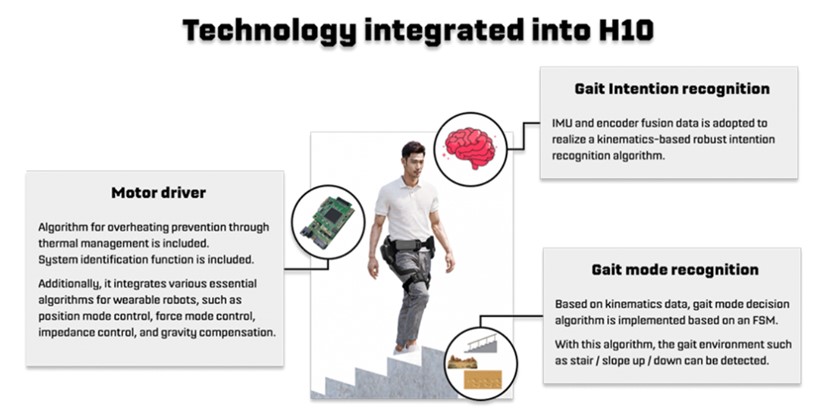
Angel Suit H10 consists of hip-assist actuators, sensor modules that measure the wearer’s motion in real time, and control algorithms for motion intention estimation and assistive torque generation. Using joint angle and angular velocity information obtained from high-resolution encoders and inertial sensors, the controller estimates the wearer’s flexion and extension intention across gait events and independently delivers assistive torques of up to approximately 15 Nm to each hip joint. The control strategy emphasizes adaptive assistance by selectively compensating for insufficient joint torque while avoiding interference with the wearer’s voluntary muscle activity.
Angel Suit H10
  • Function 1

    Smart Assistance mode

    The Smart Assistance mode provides adaptive hip joint assistance based on the wearer’s real-time walking state. By continuously monitoring joint angles, joint velocities, and gait events, the controller automatically adjusts both the timing and magnitude of assistive torque to align with the wearer’s movement pattern.
    To account for both the gravitational load of the leg segments and the speed-dependent effort associated with hip motion, the assistance profile internally combines a gravity-compensation component and a velocity-dependent component, each regulated by independent gain parameters. The gravity-compensation component provides a baseline level of assistance that unloads the hip joint regardless of walking speed, whereas the velocity-dependent component is activated only when the joint velocity exceeds a predefined threshold and increases assistance proportionally with motion speed. This control strategy is designed to deliver smooth and natural-feeling support that reduces perceived effort and hip joint loading, while preserving the wearer’s voluntary contribution.
  • Function 2

    Aquatic mode

    Underwater treadmill–based rehabilitation is highly effective for elderly individuals and patients with muscle weakness due to the inherently safe training environment. However, its practical use is often limited by high cost and time constraints. The Aquatic mode is designed to support underwater treadmills and other aquatic rehabilitation scenarios by emulating the mechanical characteristics of water-based locomotion. In this mode, the control strategy explicitly accounts for buoyancy, hydrodynamic drag, and slower gait dynamics, and adjusts the assistive pattern accordingly.
    Specifically, the controller generates an assistive profile that mimics buoyant unloading of the lower limbs while introducing velocity-dependent resistance analogous to hydrodynamic drag. The corresponding parameters can be tuned to represent different water depths or training intensities. As a result, patients can safely practice hip flexion and extension in a virtual aquatic environment that reproduces key mechanical properties of water, even in the absence of a physical pool or an underwater treadmill.


검색