Human Motion Foundation Model
KAIST Exoskeleton Lab
Human Motion Foundation Model
Understanding Human Motion from Sparse Observations
Detailed movement analysis often relies on motion capture systems and force measurements in a laboratory. Wearable sensors allow repeated measurements in everyday settings, but provide only a partial view of the body's motion and forces.
The Human Motion Foundation Model aims to recover full-body movement and biomechanical loading from limited wearable measurements. Paired wearable and laboratory recordings provide the basis for learning how signals from motion sensors and pressure insoles relate to whole-body movement.
Our research combines wearable sensing, biomechanics, machine learning and physics simulation.
Inputs
- Motion signals
- Insole pressure
- Context & masks
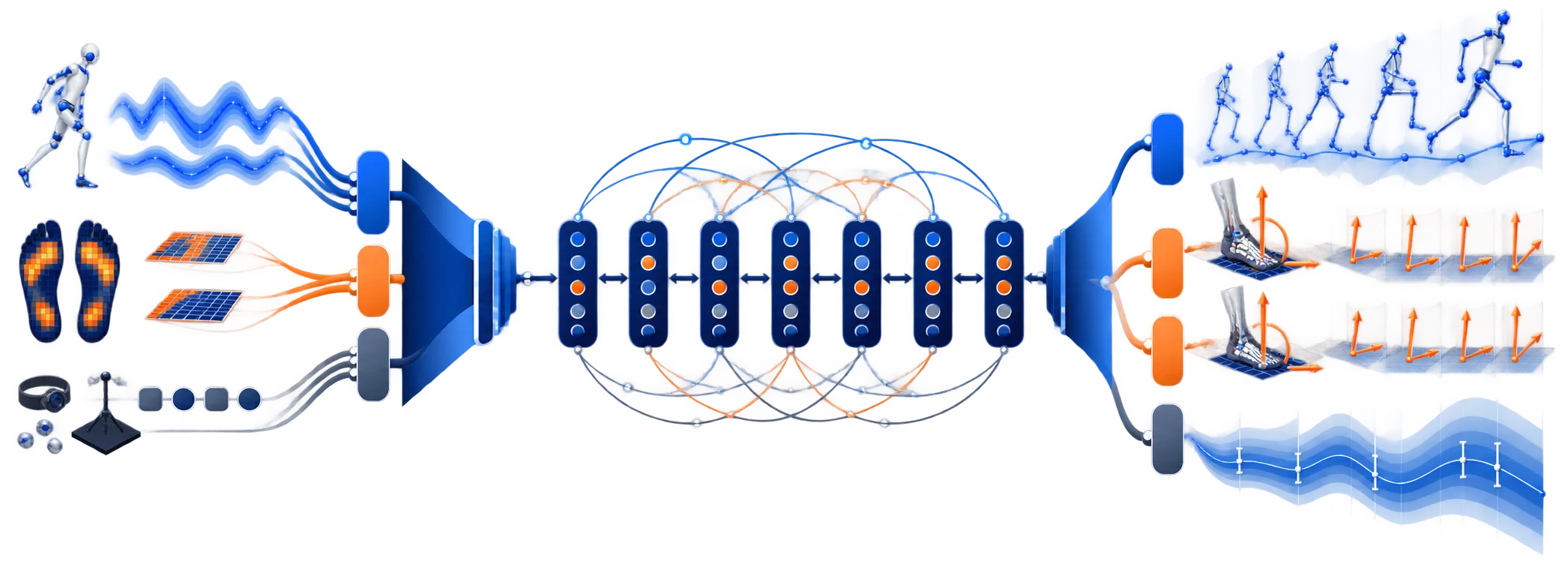 Human Movement Model
Outputs
- Body motion
- Foot forces & moments
- Uncertainty
Toward Human Movement Understanding and Wearable Assistance
Paired wearable and laboratory recordings provide the foundation for developing the Human Motion Foundation Model. Data collection across multiple sites, supported by refinement and quality checks, is intended to capture a wider range of people and movement conditions. Synthetic IMU signals will complement measured recordings.
The resulting model is intended to support human movement research and wearable assistance by connecting wearable measurements with full-body motion and force estimates. These outputs provide a basis for applications that account for how people move.
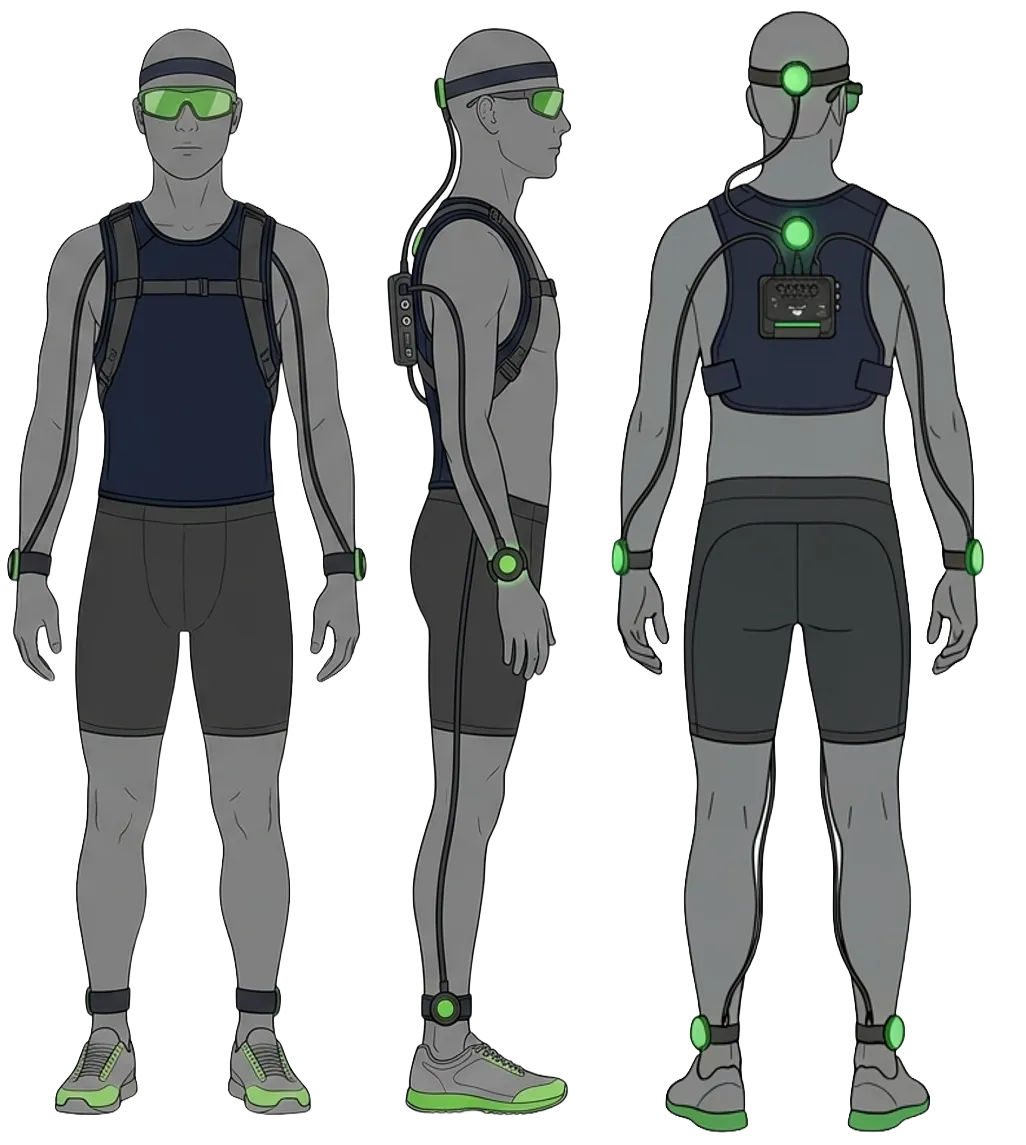
Wearable sensors
Movement and pressure measurements

Training data
Paired wearable and laboratory recordings
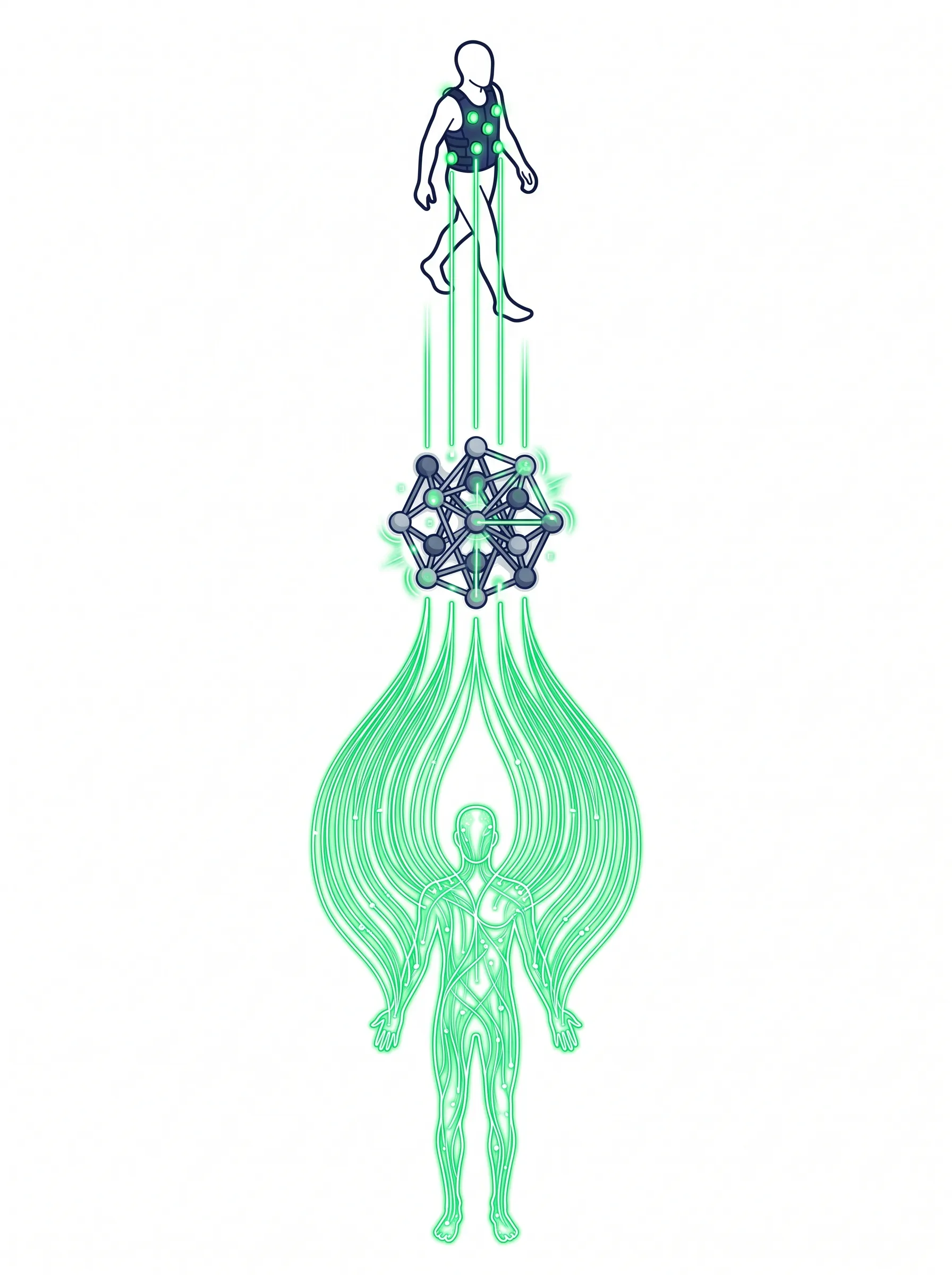
Human Motion Foundation Model
Movement and force estimates
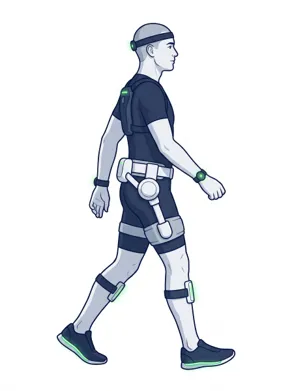
Applications
Movement research and wearable assistance
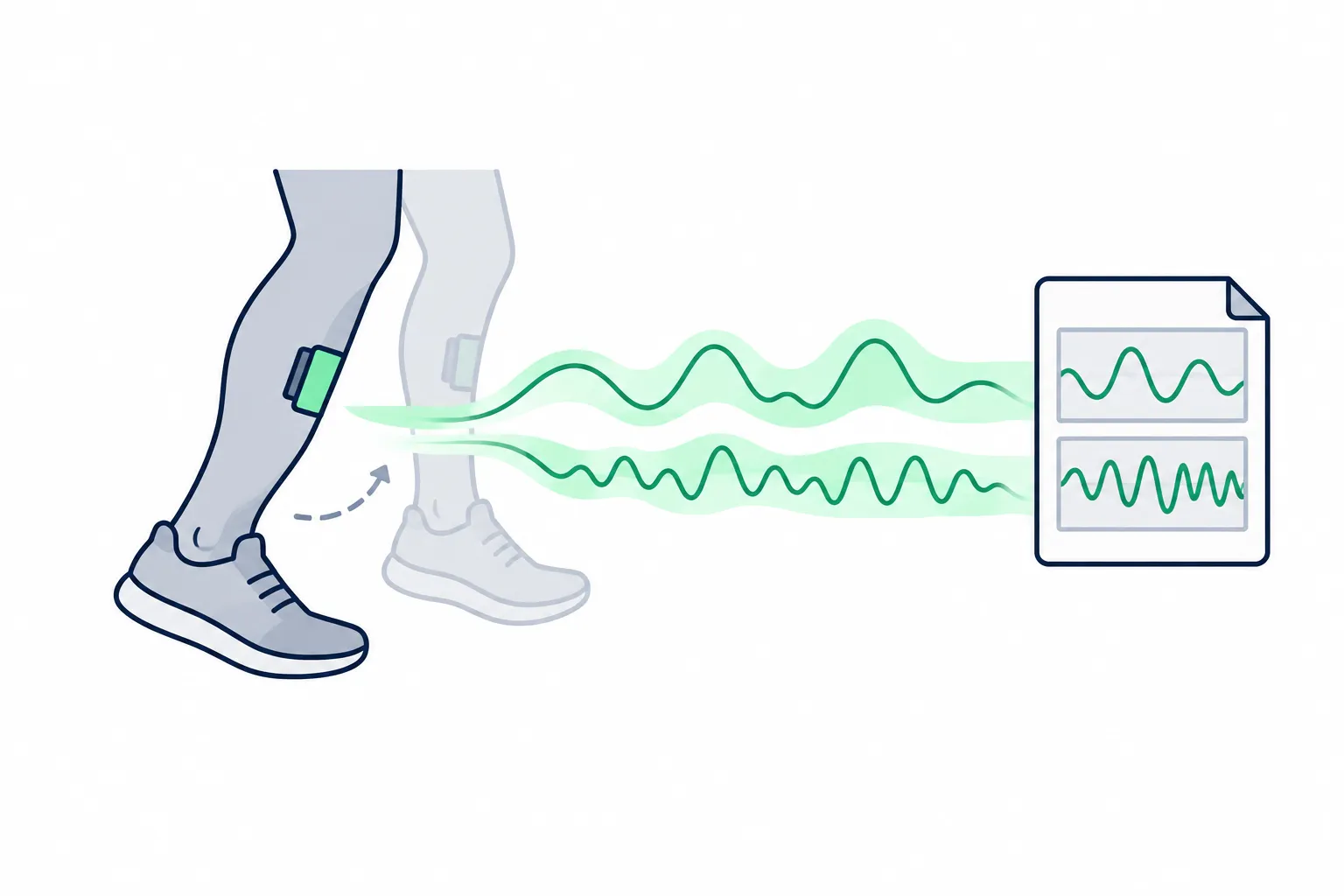
Synthetic data generation
Simulated wearable signals add to the training data.
The multi-site data behind the model follows the lab's Exo-Data Standard.
Combining Physics and Neural Models for IMU Synthesis
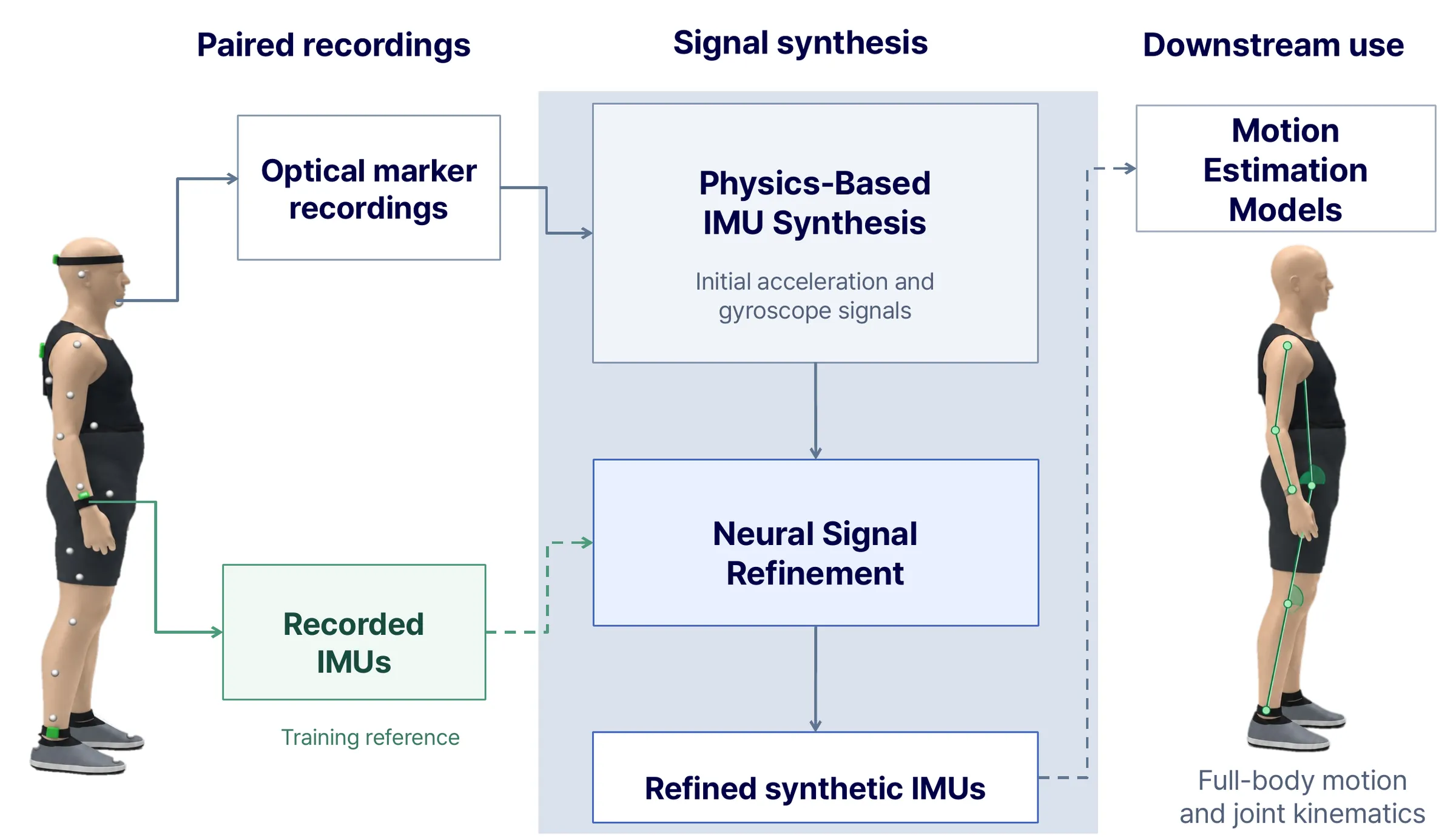
Synthetic IMU generation converts recorded human motion into acceleration and gyroscope signals. Motion-capture recordings provide the basis for physics-based signal calculation. Neural models then refine these signals to better match real IMU recordings.
This approach combines physics-based signal generation with learning from measured data. The generated signals are intended to complement recorded IMU data and support training of the Human Motion Foundation Model to recover full-body movement and biomechanical loading from sparse wearable measurements.
Physics-Based Motion Generation
The proposed approach uses a motion generator to provide a reference trajectory. An imitation policy learns to control a simulated body to follow that trajectory inside a physics simulator. Contact with the ground, gravity and joint limits constrain how the body moves.
This connects generated motion with physically plausible execution. Alongside the resulting movement, the simulator provides estimates of ground-reaction forces, joint moments and power. These outputs allow researchers to examine both how the body moves and the mechanical demands involved in performing the movement.
Movement representation
Motion features + other details
Motion Generator
Generated body motion
Imitation Learning Policy
Tracks the reference
Plausible Motion
Motion and forces